
The health of our space, that's the place for our health
Fulham Reach Boat Club is a charity – and a Sport for Good Centre of Excellence – that uses rowing to tackle social inequalities while caring for the Thames environment.
Their approach proves that environmental action and community development go hand in hand.
The charity’s mission is simple: transform lives by making rowing accessible and inclusive for everyone, especially people from underserved backgrounds.
Their motto captures their philosophy perfectly: “The health of our space, that’s the place for our health.”
Video Description
The video begins with a lively, beat-driven music track and a title slide featuring the Sport England logo and the words ‘Sport England Every Move – Case studies: Climate Justice at Fulham Reach Boat Club’.
On a blank screen, the text ‘Who are Fulham Reach Boat Club?’ slides in.
A man introduced by a caption as ‘Adam Freeman-Pask, Chief Executive Officer’ stands in a room surrounded by racks of rowing boats.
Adam says: “Fulham Reach Boat Club is an amazing sport for good charity that works with lots of different groups of people across our community.”
We briefly see a wall of photo frames with a sign that reads ‘Fulham Reach Boat Club, Est. 2014’.
The question ‘Why is climate justice important?’ appears on a blank slide.
A woman introduced by a caption as ‘Julia Philipson, Chief of Community Development’ stands in a room with rowing machines and weights.
Julia says: “Climate justice is interwoven into everything that we do here. Across our specialised programmes, we’re working with underserved communities.”
We see a wide shot of a rowing boat on the Thames, a view of the boat storage room that Adam was stood in, two people carrying a long boat beside the river and then a group of people in buoyancy vests preparing to set off in a boat from the riverbank.
Julia continues: “We see that everyone can become healthier, stronger and more connected with nature and build better connections by being out on the river, helping to clear up the river, being involved with our water testing.”
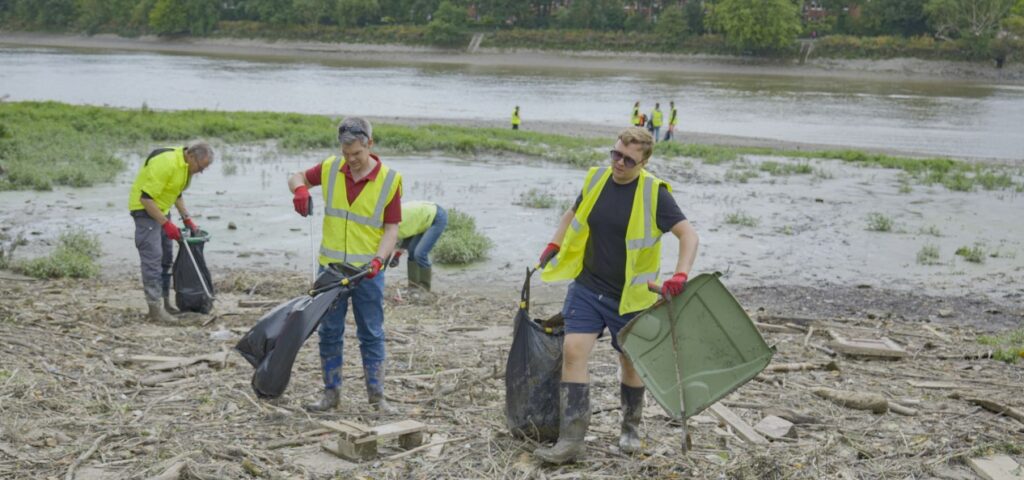
People talk on the riverbank beside a boat and then we see a group of people in high-vis vests and gloves picking litter from the side of the river, before a close-up of a thin, clear tube containing river water.
A man introduced by a caption as ‘Alastair Horn, Chief of Operations’ stands beside the river.
Alastair says: “The reason the club was set up was because of the diminishing green space in inner London.”
A rower stands beside a rack of boats outside, one of which has ‘Fulham Reach Boat Club’ printed on the side, before the scene pans out to reveal that rack as being on a pontoon on the Thames, with rowers getting ready to depart.
Alastair continues: “Having access to what we describe as the blue space is the playground for the kids. A lot of children come down here who have never rode before, maybe only half a mile away from the river and don’t even know the river’s here.”
The next question slide reads ‘What have you done to connect people from underserved backgrounds with the environment?’
Back among the racks of boats inside, Adam says: “We have three amazing pillars of our charitable work: a youth development pillar, which is all about working with young people from underserved backgrounds.”
A man talks from the pontoon to rowers in a boat, who are then shown setting off on the water.
Adam continues: “We have a crime reduction pillar, which is our ‘Boats not Bars’ programme, an amazing programme where we go into local prisons, work with people while they’re in prison and then support them on the way out as well.”
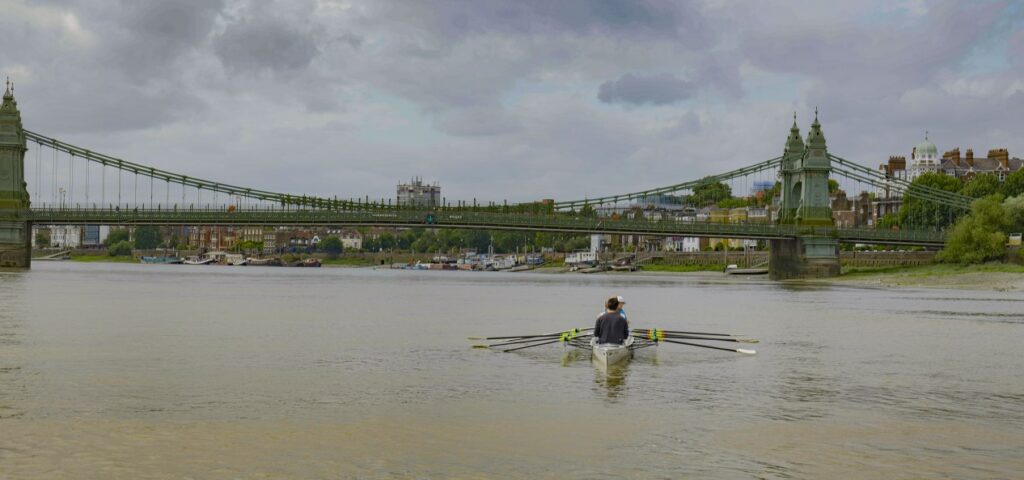
The same boat drifts out towards Hammersmith Bridge on the Thames.
Adam continues: “And then our last pillar is our accessible rowing programme, which is where we work with local disabled people, give them amazing experience to go and learn to row out here on the water.”
Three people pick litter from the riverbank beside Hammersmith Bridge.
Adam continues: “But alongside that, everything we do has got a real comprehensive environmental programme to really make sure that we are positive environmental role models.”
We see a sign for ‘Fulham Reach Boat Club, Est. 2014’ on the front of a building, then a sculpture of a seal made from netting and containing rubbish, hanging from a pipe in a room.
Adam continues: “When people come through our facility, they’re inspired by things like our seal sculpture that’s made from rubbish.”
A group of people pick litter on the riverbank and Adam is shown talking while pointing at a tube of river water.
Adam continues: “They’ll hear about our monthly river clean-ups, which are free to get involved in. Alongside that, we’ll do weekly water-quality testing, and we’ll coordinate that alongside when groups are on site, so they can learn from what we’re doing and what the water’s like. And we publish that data openly as well, so people can understand what’s going on and what state the river’s in as well.”
A grey, metal boat with an electric motor is shown on the pontoon; we zoom in to the word ‘Buzz’ printed on the side of it.
Adam continues: “And that even comes across with things like using our electric coaching boat. So when we’re out there on the water, the participants can be coached by our electric boat, which is silent and it’s charged on our pontoon. So they’ll be observing all this and be experiencing it first-hand as well.”
We see a wide shot of the electric boat moving down the Thames, a close-up of a black box on the boat, more rowers in action, and life rings hanging on the side of the pontoon.
The next question slide reads ‘How are you delivering these programmes?’
By the river, Alastair says: “We give access to children from literally all backgrounds, all walks of life. Once they get a bit of confidence, it’s incredible how they open up, their confidence grows and their ability to learn improves.”
We see Alastair walking and talking with an oar beside a boat in front of Fulham Reach Boat Club, before a young man talks beside a boat.
Alastair continues: “To make sure that all children have access to the water, we subsidise the state schools by 75% and to do that we have two full-time fundraisers. The adult subs also help cover it and the private schools help offset.”
Three female rowers stand beside boats outside the club and then Alastair carries a boat inside.
The next question slide reads ‘What is your advice for others?’
Back in the room with the rowing machines and weights, Julia says: “So my advice would be just to get involved, just to start to do something.”
The female rowers from the previous scene walk beside a boat outside the club and we then see close-ups of photos of rowers on the wall inside, before two men carry a boat out and Alastair talks to the rowers.
Julia continues: “We had to start from somewhere. And our environmental action really means that we engage much more with our community. We meet people that come to our club now and walk through our door who would never have done before. We have better corporate engagement. All because all of these people want to do something for our environment.”
Adam is shown in an office and then talking to his staff on the pontoon; they’re all wearing high-vis vests. A woman gesticulates with her hands while coaching someone in a boat, a man crouches beside other rowers in a boat and two people pick litter from the shore.
Adam says: “We just want to inspire people with what we do. We love it when other people try and replicate that or build on what we’re doing. And hopefully we can inspire more sports clubs across the country to really think about what environmental impact they can have.”
The background music fades up and the video ends with a blank slide that says ‘Created by’ above the logos of Useful Projects (part of the Useful Simple Trust and a social enterprise and B Corp sustainability consultancy) and Pictures for the People (a social enterprise video production agency).
Why have they taken action?
As a rowing club based on the Thames, environmental stewardship was a clear responsibility. Rowing is inseparable from the natural environment, and the charity feels a duty to act where the sport intersects with climate and environmental challenges.
They identified an injustice: there was poor access to nature in their local area, with some residents not even aware the river – and opportunities to enjoy it – existed nearby.
This unequal access reflects wider environmental and social inequalities, presenting both a challenge and an opportunity – to engage the local community with their environment while supporting health and wellbeing.
How have they done it?
Environmental stewardship
The charity is committed to being positive environmental role models through practical action:
River clean-ups
The charity organises regular river clean-ups for the local community and as a corporate volunteering activity.
They have found it to have multiple benefits: as an accessible entry point to engage new people with the river, and an important task since the charity is located at a bench and bend on the river where rubbish naturally accumulates.
So far, 327 people have participated, collecting 1,416kg of waste.
Water quality monitoring
The charity conducts regular water-quality testing and shares data through a live, open-access tool. The data serves as both a reminder of climate change impacts and protection for participants’ health, identifying when the water is unsafe for rowing activity.
Electric boat adoption
The charity switched to an electric coaching boat in January 2024, and has since installed an electric charging point on its pontoon, which it makes available to 30 other rowing clubs within 6km to reduce range anxiety.
Reaching under-served communities
The charity provides rowing opportunities for people from under-served backgrounds through three key programmes:
Youth development
Working to improve the physical and mental wellbeing of young people, via a pathway of state school rowing, free watersport weeks and junior courses, and a junior squad with bursary places.
Crime reduction via Boats Not Bars programme
Starting in 2019, the aim is to reduce reoffending rates through providing structured opportunities in prisons through rowing. So far, they have worked with 677 people in prison and 69 people have now been supported after release with a further three participants referred to the project from other organisations.
Accessible rowing
Launched in 2025, the programme ensures rowing is accessible and adapted to people with disabilities, with the aim to ‘coach the person in front of you, not the sport’.
Intersecting the social and environmental action
The charity deliberately weaves environmental awareness into all community programmes:
- River clean-ups serve as welcoming first experiences for nervous newcomers
- Environmental education – on water quality, pollution impacts and climate change – happens alongside rowing coaching
- Environmental issues are amplified in public spaces, with a seal sculpture made from rubbish from the river hung up in the boat house, and environmental stewardship tips showcased on the noticeboard
- Participants are supported to become environmental advocates through hands-on experience.
“Engaging with the environment is often an easier sell than taking up a sport,” the team explains.
“Once engaged, confidence grows and people start to engage in the sport and get healthier from it.”
Funding opportunities
The charity uses a blended funding approach, including:
- Council grants and Port Authority support
- Two full-time fundraisers focused on their three charitable pillars
- Youth development programme subsidised through adult subscriptions, independent school partnerships and crowdfunding
- Volunteer support for practical activities like clean-ups.
Outcomes
- 327 people participated and 1,416kg of waste collected in river clean-ups
- 30 rowing clubs in 6km have access to the new electric charger on the pontoon
- Regular water-quality data shared publicly to raise environmental awareness
- 150 people engaged through prison programmes, with 20 supported post-release
- 1,000 young people engaged from 15 schools
- Community Sport Club of the Year 2024
- World Rowing Programme of the Year 2024.
Top tips
Just get started
Start, recognise your obstacles, and move through them. Don’t wait for perfect conditions – begin with what you can do today.
Make environmental action integral
Interweave environmental action into everything you do. It should be ever-present and then people will start to understand that action isn’t difficult but just part of the process.
Think beyond your sport
Using the environment as a gateway to engage a larger community is often an easier sell than taking up a sport.
Environmental stewardship and social action can attract people who might never have considered your sport, but once engaged, they often stay and benefit from both the activity and the community.